5th August 2025

What is a HDMI Connector?

What is a HDMI Connector?

As an electronic component distributor, we understand the importance of reliable connectivity solutions across all industries. HDMI (High-Definition Multimedia Interface) connectors are a key component in ensuring high quality transmission of digital video and audio signals. Commonly used in consumer electronics, industrial equipment and professional AV systems, HDMI connectors offer a simple, all-in-one solution for connecting displays and devices.

There are five types of HDMI connectors; A, B, C, D and E, these types are based on the size and shape required. However, in this post, we will explore the 3 predominant types of HDMI connectors available and highlight their key features and benefits. The most used HDMI connectors today are Type A (Standard), Type C (Mini), and Type D (Micro). Some of these have expanded to include more support with Version 1.0 supporting 1080P video and 8-chanel audio to the newly released (as of January 2025) version 2.2 capable of support for up to 16K resolution. Although the physical design of the Type A connector, with its 19-pin layout, has remained the same, its capabilities have greatly improved for present-day needs.

HDMI Type A (1.0 - 2.2) (Standard)

Let’s start with the most widely used HDMI connector; Type A, also known as the standard HDMI, which was created in 2002. The initial goal was to create a single digital interface for both audio and video, replacing multiple analogue connections offering better quality and convenience. This 19-pin connector is the largest among the HDMI types and is commonly found on a wide range of devices. It’s typically used to connect source devices such as set-top boxes, gaming consoles, Blu-ray players, and computers to display devices like TVs, projectors and monitors. Type A HDMI supports digital transmission of both high-definition video and multi-channel audio, accommodating resolutions ranging from 1080P to 16k @ 60Hz. Due to its versatility and widespread compatibility, the standard HDMI connector (Type A) is the most prevalent of all HDMI types, featured across nearly all brands of TVs, computer monitors, streaming devices and desktop computers.

HDMI Type C (1.3-2.1) (Mini)

Type C (Mini) HDMI connectors made in 2006 are compact digital interfaces designed to deliver high-definition audio and video signals from portable devices to larger display systems. This smaller form factor allowed for the integration of high-definition multimedia interfaces into more compact devices. Like standard HDMI connectors, Mini HDMI also uses a 19-pin configuration and supports high-definition formats, including 10K, ensuring excellent audio and video quality. Despite their smaller size, Mini HDMI connectors offer the full functionality of standard HDMI ports. Commonly found on DSLR cameras, camcorders, tablets and some laptops, they provide a convenient solution for connecting compact electronics to TVs, monitors and projectors. HDMI Type C (Mini HDMI) connectors can technically support versions higher than 1.4 however it is rare to have these supporting HDMI 2.0 or higher.

HDMI Type D (1.4b) (Micro)

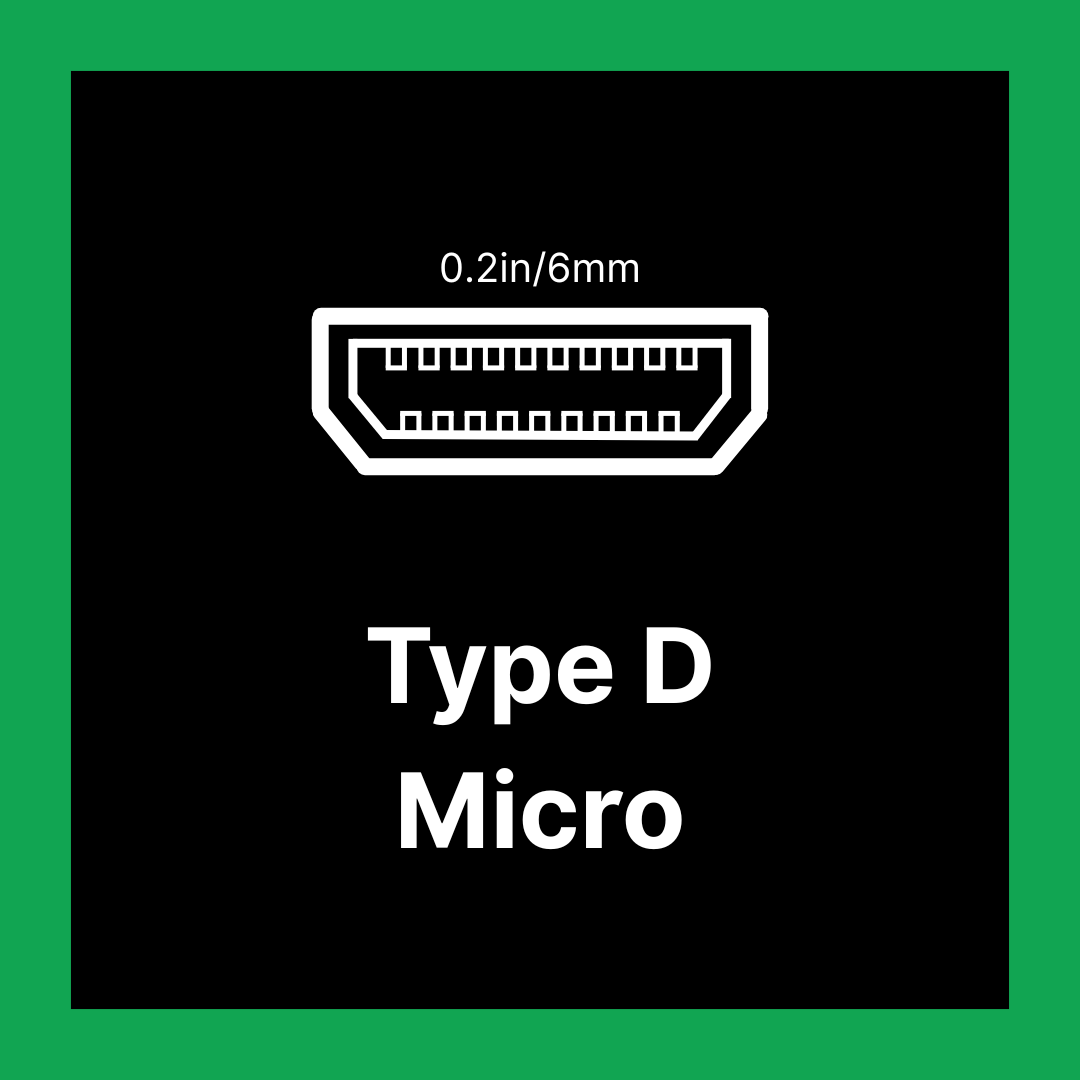
Type D (Micro) HDMI connectors take miniaturisation a step further, delivering a highly compact yet fully functional solution for transmitting high-definition audio and video from ultra-portable devices. It was introduced to meet the growing demand for smaller connectors in devices like smartphones and cameras in 2009. Despite being even smaller than the Mini HDMI, Micro HDMI maintains the same 19-pin configuration and supports the full range of HDMI features, including 1080p to 4K resolution. It is commonly found on slim digital cameras, smartphones and compact tablets, where there isn’t as much room for larger ports. A typical Micro HDMI cable features a Micro connector on one end and a standard Type A connector on the other, enabling seamless connection to TVs, monitors and projectors. This makes it an ideal choice for users who need powerful multimedia capabilities in a small space.

The transition from HDMI to USB-C:

Many new devices are shifting from Micro HDMI to USB-C, driven by the demand for slimmer designs and more versatile connectivity. USB-C’s compact size and ability to handle video, audio, data, and power through a single port make it an attractive alternative for manufacturers. While adapter cables are available to connect USB-C to HDMI displays, they typically operate using HDMI 1.4b standards limiting output to 4K at 30Hz. For users requiring higher resolutions or refresh rates, such as 4K at 60Hz or 8K video, only HDMI version 2.1 or higher can meet those demands. Though USB-C offers impressive multifunctionality, it comes with trade-offs in video performance when compared to the latest HDMI standards.

How to know which HDMI to use:

Overall, knowing which HDMI cable and connector to use depends on both identifying the cable and understanding your device requirements. You can determine the cable type by checking the text printed on the cable itself, or examining the original packaging, these often indicate the HDMI version. Once identified, match the cable to your needs; for standard 1080p displays, a High-Speed HDMI cable is typically enough. However, if you’re working with 4K or higher resolutions, faster refresh rates or features like Ethernet or Audio Return Channel, a Premium High Speed or Ultra High-Speed HDMI cable is necessary such as Type A 2.2. By considering both the cable’s specifications and your equipment’s requirements, you can ensure optimal performance and compatibility.

At Live Electronics, we are here to help you make the right choice. We carry a range of HDMI connectors to ensure compatibility and performance. Whether you’re outfitting a high-performance vehicle or building a cutting-edge production setup, Live Electronics is your trusted source for reliable, industry-grade HDMI solutions.