Home » Technical News » Industrial Connectors: What Engineers Should Consider Beyond Pin Count
Industrial Connectors: What Engineers Should Consider Beyond Pin Count
When specifying industrial connectors, it can be tempting to treat pin count as the primary selection factor. It defines how many signals or power circuits you need, so it feels like a logical starting point.
But in practice, pin count only tells part of the picture. Operating environments, mechanical demands and electrical challenges all introduce a much broader set of considerations. Getting these right at the specification stage is considerably less costly than dealing with failures once equipment is installed and in use.
Ingress Protection
Ingress Protection (IP) is a standardised measure of how well a connector resists the entry of solid particles and liquids. The rating is expressed as two digits. The first covers protection against dust and solids, the second against water. An IP67-rated connector is fully dust-tight and can withstand temporary immersion, while IP68 extends that protection to continuous submersion.
A common mistake is selecting a connector with an adequate IP rating on paper without accounting for how it behaves when disconnected or only partially engaged. A connector’s IP rating applies in its fully connected state, meaning both halves fully plugged together and locked. In practice, connectors on maintenance access points or portable equipment that is regularly moved and reconnected may spend significant time unmated, exposing the seal to contaminants over time. Some connectors are available with protective caps for the unmated half for this exact reason, helping to preserve the seal when disconnected for extended periods.
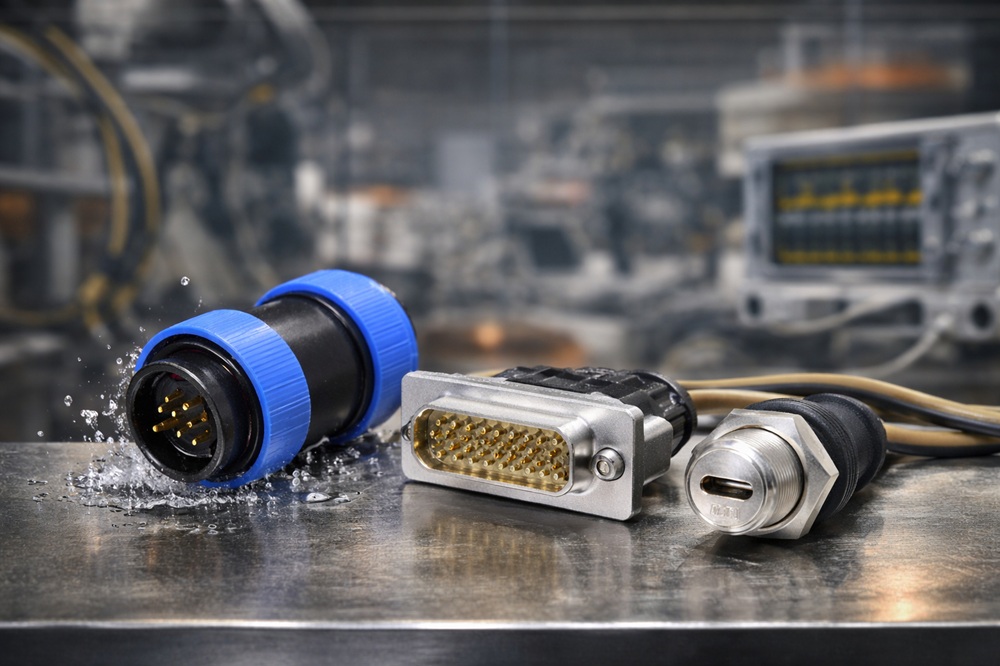
Different connector ranges handle this in different ways. Screw-lock and bayonet-coupling circular connectors provide a secure, repeatable connection interface with consistent sealing force. This makes them well-suited to environments where vibration or accidental disengagement are concerns. Push-pull connectors, used widely in applications requiring frequent connection and disconnection, can maintain IP67 or IP68 ratings across their full connection cycle. This is a critical consideration in factory automation or outdoor instrumentation.
For applications requiring data or USB connectivity alongside environmental sealing, rugged IP67 and IP68-rated USB connectors are worth considering. These are available with USB-C options and extend the same level of protection to interfaces not originally designed with industrial environments in mind.
EMI Shielding
Electromagnetic interference is a persistent challenge in industrial settings. Variable speed drives, motor controllers, switching power supplies and high-current cabling can all generate significant electrical noise. For signal-level circuits running in proximity to these sources, even a well-designed cable assembly can become an antenna if the connector interface introduces a break in the shielding.
Effective EMI shielding at the connector level requires 360-degree circumferential contact between the cable shield and the connector’s metal housing. Partial or intermittent contact significantly reduces shielding effectiveness. In circular connector designs, the metallic shell itself contributes to this shielding, which is one of the reasons circular connectors remain a preferred choice in demanding EMI environments. The circular design provides a continuous conductive enclosure around the connection point.
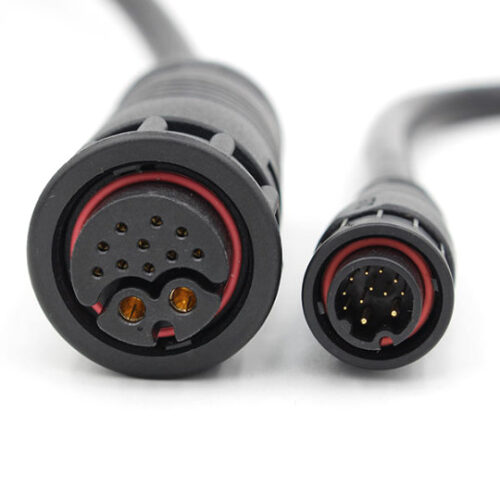
Hybrid connectors, which combine power and signal circuits within a single connector body, are worth particular consideration from an EMI standpoint. By integrating both circuit types into one shielded enclosure, they can reduce the number of potential ingress points for interference. This also simplifies cable routing and reduces panel cutout requirements. For applications where both power delivery and signal integrity are critical and space is at a premium, this can be a practical engineering trade-off.
Filtered D-sub connectors are also worth considering in EMI-sensitive applications. These have built-in filtering components that suppress specific frequencies of interference, making them a dedicated solution where shielding alone may not be sufficient.
Mating Cycles
Every connector has a rated connection cycle life. This is the number of times it can be connected and disconnected before contact resistance begins to degrade or mechanical failure becomes a risk. In permanent or semi-permanent installations where connectors are plugged in once and left undisturbed, this may not be a critical factor. But in applications involving regular maintenance access, test and measurement connections or field-replaceable modules, connection cycle life becomes a key consideration.
Different coupling mechanisms have different implications here. Screw-threaded connectors offer high retention forces and are well-suited to applications with significant vibration. However, they take longer to connect and disconnect, which can slow things down in high-throughput production environments. Bayonet-coupling connectors provide a positive lock with fewer turns, balancing speed and retention. Push-pull connectors are designed for rapid, tool-free connection and are rated for a high number of connections and disconnections, making them practical where frequent disconnection is expected as part of normal operation.
Contact material and coating also matter. Gold-plated contacts offer lower and more stable contact resistance across a high number of connection cycles. They are preferred in signal applications where any increase in resistance would affect performance. For power contacts carrying higher currents, the coating needs to be robust enough to handle the additional wear that comes with repeated use.
Durability
Durability in industrial connector selection extends beyond the connector itself. How it is mounted, how the cable is managed at the entry point and the locking method all contribute to how the assembly holds up under mechanical stress over time.
Vibration is a cause of failure that is often underestimated at the design stage. A connector that performs well in lab conditions may behave very differently in an application subject to constant or intermittent vibration. If the locking method allows any movement between the contact surfaces, repeated micro-movement can gradually wear away the coating and increase resistance over time. This can happen even without the connector fully disconnecting. Choosing a connector with an appropriate locking mechanism helps address this. Ensuring cables are properly supported so that vibration loads are not transferred directly to the connector is equally important.
For DC power applications, combined connector and switch assemblies are worth considering. These integrate a pushbutton, rocker switch or slide switch directly with the power connector. This is useful where control functionality and power connection need to share a limited space. It also removes the need for separate components that each introduce their own potential weak points.
Specifying Connectors That Will Last
The range of industrial connectors available today covers an enormous variety of application requirements. From high-current circular connectors designed for demanding environments, to rugged USB and DC power connectors built to function reliably in challenging conditions, there is a solution for most applications.
Getting the specification right means looking beyond pin count from the outset. IP rating, EMI shielding, connection cycle life and mechanical durability each add layers of complexity to the selection process. Addressing them early is considerably less costly than dealing with failures once equipment is in use.
Live Electronics can offer a range of industrial connectors across multiple product ranges and has the technical knowledge to help match the right product to your application. If you are working on a connector specification and would like some guidance, get in touch with the team today.